
Water Heater Leak Cleanup in Rockville, MD: From a Tank Drip to Dry Floors and Walls
A water heater holds dozens of gallons, and it usually sits in a closet, a corner of the basement, or a garage where nobody looks. When it leaks, the water can spread for hours before anyone notices. Rockville Restoration Expert removes the water, dries the floors and walls around the heater, and checks for hidden moisture in homes, condos, and commercial buildings across Rockville, Maryland.
Estimates are free, and our line is open at any hour. A plumber repairs or replaces the heater, and we take care of the water damage it caused.
- 24/7 Emergency Calls
- Free Estimates
- Licensed and Insured
Find Out Where the Water Is Coming From
Not every puddle near a water heater means the tank has failed. Knowing the source tells the plumber what to fix and tells us how far the water may have traveled.
Pipes and Fittings on Top
The inlet and outlet connections sit on top of the tank. A loose or worn fitting can drip down the side and look like a leak from the tank. This is often the cheapest kind to fix.
The Relief Valve and Its Discharge Pipe
The temperature and pressure relief valve is a safety part. If it is dripping or running, the heater may have excess pressure or temperature, and a plumber should look at it promptly.
The Drain Valve Near the Bottom
A drain valve that is not fully closed, or has worn out, can drip steadily at the base of the tank.
The Tank Itself
Water seeping from the bottom of the tank or through its jacket usually means the tank has corroded through. The heater typically needs to be replaced.
Condensation, Not a Leak
On a cold tank or pipe, moisture can bead and drip without any failure. If a small amount of water appears only at certain times, ask a plumber to check before you assume the worst.
Shut It Down Safely First
- Turn off the power or gas to the heater. Use the breaker only if the panel is dry and you can reach it without standing in water, or the gas shutoff on the line.
- Close the cold water supply valve on the pipe going into the heater.
- Stay out of deep water if the heater, cords, or outlets are in it.
- Take care with hot water, which can scald skin if it sprays or pools.
- Photograph the heater, the water, and the surrounding area before cleanup.
- Call a plumber for the heater and call us for the water damage.
What We Clean Up and Dry After a Heater Leak
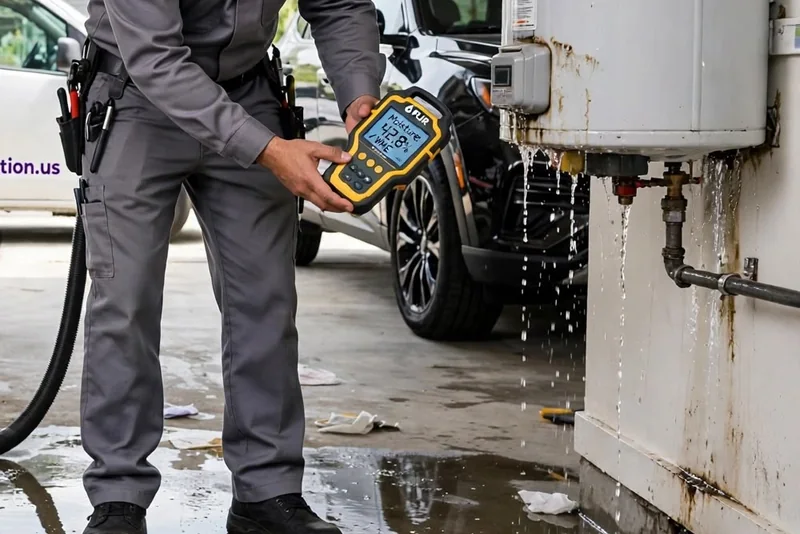
Water from a heater rarely stays on the floor beneath it. It runs under nearby walls, soaks stored boxes, and can seep into the floor below. Our crews start with water extraction and removal to clear standing water, then check these areas with moisture meters:
- The floor under and around the heater, including flooring edges and the subfloor.
- The wall bottoms behind and beside the unit, where drywall and insulation wick up water.
- Stored items such as boxes, paint cans, and laundry supplies in the same space.
- The ceiling below, if the heater sits on an upper floor or in an attic.
- Nearby rooms, since water follows floors and baseboards.
We then dry the area with air movers and dehumidifiers, as explained on our structural drying and dehumidification page.
Where the Heater Sits Changes the Job
Basement Utility Rooms
A basement heater leaks onto concrete, which tolerates water well, but the water can reach finished rooms next door. Our basement water damage page covers that wider cleanup.
Closets in Condos and Townhomes
A heater in a closet may sit against a shared wall or above a neighbor's ceiling. We check adjoining spaces and work with building management so the cleanup does not stop at your door.
Attics and Upper Floors
When a heater is on an upper level, the first sign of a leak may be a stained or dripping ceiling below it. We check the ceiling, the insulation above it, and the floor around the unit.
Garages and Utility Areas
Garages often have hard floors and little finishing, but stored items and attached walls can still be damaged. We dry what can be dried and tell you what should be thrown out.
What We Leave to the Plumber
Repairing a heater, replacing a failed tank, and testing the relief valve belong to a plumber, who can also confirm that a gas appliance is safe to restart. Our part is the water that escaped. We coordinate so the plumber can work while we dry, and we avoid leaving open walls that block access to the repair.
Warning Signs Before a Heater Fails
- Rust-colored water or rust streaks on the tank or fittings
- A damp spot or a small puddle at the base that comes back
- Rumbling or popping noises from the tank
- A mineral crust around connections
- A tank that is old, since many last roughly 8 to 12 years, though the label and your plumber know best
If you see these signs, call a plumber before the tank fails. A planned replacement is usually less costly than an emergency one.
Slow Leaks and Mold
A small, steady drip can soak a floor or wall bottom for weeks. By the time a stain shows, materials may be damp enough to grow mold. If a heater leaked slowly, tell us so we can measure carefully. Our mold remediation page covers what happens when mold has already started.
Insurance and Water Heater Leaks
Many policies cover damage from a sudden failure, but not the failed heater itself, and may treat a slow leak differently. Photograph the heater and the area before cleanup, keep the plumber's invoice, and tell your insurer early. We document what we found and what we did. Coverage is your insurer's decision, and we cannot promise a claim will be paid.
Water Heater Leak Cleanup Across Rockville
We clean up after water heater leaks in Rockville Town Center, King Farm, Fallsgrove, Twinbrook, East Rockville, West End, Woodley Gardens, College Gardens, Lincoln Park, Hungerford, New Mark Commons, and the other neighborhoods in ZIP codes 20850, 20851, 20852, 20853, 20854, and 20855. Give us your street address when you call, and we will tell you whether we can reach it.